
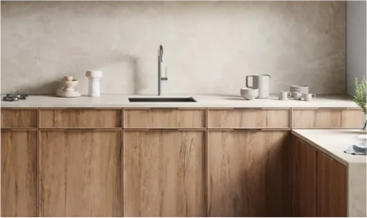
A kitchen remodeling project is one of the most exciting and significant upgrades you can make to your home. At the center of any dream kitchen layout is the countertop. Not only does it act as the primary workhorse for daily food prep, but it also serves as the visual centerpiece that ties your cabinets, backsplash, and flooring together.
However, when looking through natural stone slabs or engineered surfaces, the variety of choices can quickly become overwhelming. Homeowners are often torn between the distinct beauty of natural patterns and the structural uniformity of engineered products. To help you choose the right fit, we break down the three most popular luxury options: Granite, Quartz, and Quartzite.
1. Granite: The Natural Powerhouse
Granite has long been the gold standard for high-end kitchen countertops, and for good reason. As a natural igneous rock quarried directly from the earth, no two slabs of granite are ever identical. This means your kitchen island will feature unique veins and flecks that cannot be copied.
Pros: Excellent resistance to direct heat, scratch-resistant surface, and highly durable. Under normal conditions, hot pans can be placed directly on granite without risk of thermal shock.
Cons: Being a natural stone, granite is porous. It requires regular sealing (typically once a year) to prevent liquids like red wine or cooking oils from seeping into the stone and creating permanent stains.
2. Quartz: Engineered Perfection
Engineered quartz is made by combining roughly 90-93% crushed natural quartz crystals with polyester resin binders and color pigments. Because it is manufactured, it provides perfect pattern consistency across multiple slabs, making it ideal for large kitchens that require seamless seam matching.
Pros: Non-porous surface that never needs to be sealed. It is highly resistant to stains, acids, and bacterial growth. Simply wipe down with soap and water to maintain its luster.
Cons: It is not heat-proof. The resin binders can melt or discolor if exposed to high heat. You must use trivets and hot pads to protect the surface from hot pans.
3. Quartzite: The Exotic Luxury
Not to be confused with engineered quartz, quartzite is a 100% natural metamorphic rock that begins as sandstone and is transformed under extreme heat and pressure. It offers the elegant look of white marble but has the hardness and durability of granite.
Pros: Extremely hard, highly scratch-resistant, and features elegant, flowing veining patterns. It gives a luxurious appearance that makes a bold statement.
Cons: Similar to granite, it is porous and must be properly sealed to prevent staining. It is also one of the more expensive materials due to the complex excavation and diamond-blade cutting processes required.

This buying guide is exactly what we needed! My wife and I are planning a kitchen remodel in Marietta, and were torn between granite and quartz. The maintenance section really clarified the pros and cons of sealing.
Hi John, we're glad the guide helped! If you tend to cook with heavy spices or oils, engineered quartz is usually the lower-maintenance choice. However, granite's heat resistance is unmatched if you like putting pans straight down. Let us know if you'd like us to bring stone samples to your home for a free estimate!
Do you carry samples of Calacatta Gold Quartz? We want to see how the gold veins look under our warm under-cabinet LED lights before deciding.